My Story
HOW POSITIVELY CHRONIC_ CAME TO BE
Heya, I'm Katya! I created Positively Chronic_ to share my experiences of living with multiple disabling chronic illnesses, the adaptations I've made to navigate daily life, and the things I've learnt along the way that might help somebody else in a similar position, but there's quite a backstory to how this all came about!
My health conditions only became significantly more disabling in my twenties, and over the past eight years or so, life has taken me in directions I never could have imagined. From spending over a year more or less housebound after diagnosis, to quitting my job to travel around Southeast Asia, building a business that accommodates my health, getting married abroad and now navigating motherhood.
So I thought I'd take you right back to the beginning, because whilst you might see little snippets of my life here, there's SO much that happens behind the scenes to make those experiences possible...

IT ACTUALLY STARTED IN CHILDHOOD
Looking back, there were so many signs that something wasn't quite right with my health, but at the time I genuinely thought they were normal. I was never particularly sporty, had absolutely terrible proprioception (basically awareness of where my body is in space), and would regularly experience headaches, tummy aches, fatigue and various aches and pains.
I was much more in my element doing arts and crafts, cooking and other creative activities indoors than running around outside, and whilst some of that might just be my personality, I do sometimes wonder how much was because I was already experiencing symptoms of the conditions that would eventually be diagnosed in my twenties.
My mum experienced lots of similar symptoms too, so neither of us really recognised anything as being particularly unusual. We now know that she also has Hypermobile Ehlers-Danlos Syndrome (hEDS), a genetic connective tissue disorder, and she was only diagnosed around the time that I was.
During my teens, I also started having occasional joint dislocations, but these were dismissed as 'benign joint hypermobility'.
So I continued through childhood and my teenage years experiencing all these different symptoms, without anybody really connecting them together. The first 'dislocations' were when I was in my late teens and started uni; first on the ski trip where I fell and dislocated my knee and then when I tried to snap a half portion of frozen quinoa (as I didn't want to defrost and eat it all) and I assumed my thumb would naturally stop when it couldn't go further, but low and behold - with EDS that's not the case!


WHEN MY HEALTH STARTED TO DETERIORATE
Things then changed significantly when I was 21. I had finished uni and started work at a film production company. Weeks in, my appendix removed, followed by another abdominal surgery a few weeks later to remove adhesions.
I wasn't advised to do any particular strengthening or rehabilitation afterwards, and over the following 18 months I developed a chronic daily migraine that nobody could really explain. At the time I was working in a fast-paced film production company, and I was trying to continue with life and work whilst managing constant pain and all these other symptoms, and then came one of the most random moments that would ultimately lead to my diagnosis!
One morning, after not having done any particular strengthening exercises for ages, I decided to do an ab-bike exercise on my very soft, spongey bed. Yes, very random, haha. And in doing so, my coccyx, or tailbone, partially dislocated for the first time. It was absolutely AGONISING.
What I didn't know then was that this wasn't just an isolated injury. My coccyx would go on to become one of several joints that now regularly partially dislocate, alongside my hips, lower spine, neck, shoulders and knees. That incident became part of the process that eventually led to discovering what had been happening in my body for years.


FINALLY GETTING A DIAGNOSIS
When I was 23, I was diagnosed by a rheumatologist at the London Hypermobility Unit/Network with Hypermobile Ehlers-Danlos Syndrome and several associated conditions. After years of seemingly unrelated symptoms, suddenly there was an explanation connecting so many of the things I'd experienced since childhood.
hEDS is a connective tissue disorder, and because connective tissue is found throughout the body, it can affect so much more than just our joints. For me, this meant understanding why I'd experienced things like joint instability, chronic pain, fatigue, gastrointestinal issues and other symptoms that had previously been treated as separate problems.
Over the years, my medical history has also come to include conditions such as PoTS, cervical instability, vestibular migraine, MCAS and various gastrointestinal conditions, amongst others. Of course, everyone's experience of these diagnoses can look completely different. Two people can have the same condition, yet have very different symptoms, limitations and needs. For me, the diagnosis was a strange combination of relief and grief.
Relief that there was finally an explanation, that I wasn't imagining everything and that the symptoms could be understood as part of a bigger picture. But also the enormous realisation that these were chronic conditions, and that my life might look very different from what I'd imagined.


LEARNING TO NAVIGATE A DIFFERENT LIFE
Following my diagnoses, I went through a really difficult period mentally. I was in my twenties, working in a career I'd spent years building, and suddenly having to come to terms with the reality of living with multiple disabling health conditions.
I had so many questions about what the future would look like.
-
Would I be able to continue working?
-
Would I ever feel well enough to travel?
-
How was I going to manage the pain, fatigue and unpredictable symptoms every day?
Perhaps one of the hardest things was realising that so much of the way I'd been living needed to change.
I began working from home with adjustments to my job and spent an enormous amount of time researching, learning about my conditions and experimenting with management strategies recommended by my healthcare professionals.
From physiotherapy and adapting my environment to changing how I planned my days, learning to pace myself, managing medications and figuring out what helped different symptoms.
There was SO much trial and error involved.
Even now, years later, I'm constantly having to adapt as my conditions change or new situations arise. But gradually I started to understand my body better and find ways to make life a little more manageable.

BUT WHAT ABOUT MY DREAM OF TRAVELLING?
Before my health deteriorated, Rob and I had been saving up and dreaming of quitting our jobs to travel. We'd been together since I was 19, and the idea was to explore the world together for as long as we could, but after my diagnoses, that dream suddenly felt completely impossible.
I was struggling with everyday life at home, let alone imagining myself on long-haul flights, moving between destinations and navigating unfamiliar environments, and trying to research travelling with my particular combination of conditions was incredibly frustrating.
I wanted somebody to tell me what I needed to prepare, which destinations might be accessible, what to pack, how to manage my medical requirements and whether travelling could realistically be possible, but I couldn't find one place that brought all the information together.
So I decided to do the research myself.
For around 15 months, I spent my evenings meticulously researching everything we'd need to consider. Medical supplies, medications, accessible accommodation, transport, dietary requirements, mobility assistance, pacing, emergency plans and SO many other things.
After several months we even took a practice long-haul trip to test whether it was possible... and thankfully, it was!
Not without adaptations, limitations and a huge amount of preparation, but it gave me the confidence that perhaps we could still make our dream happen.

QUITTING OUR JOBS AND TRAVELLING SOUTHEAST ASIA
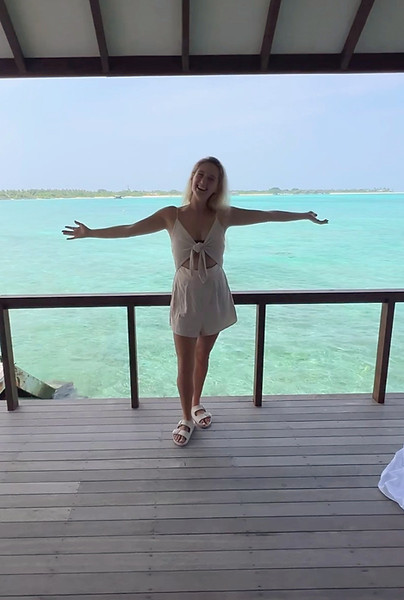
In December 2019, after all that preparation, Rob and I finally quit our jobs and set off to travel around Southeast Asia indefinitely. It felt like such an enormous achievement after everything that had happened over the previous couple of years.
It was during this trip that I created Positively Chronic Travels.
I'd spent so long gathering information and learning how to make travelling more accessible for my particular needs that I wanted to share it, in case it could save somebody else some of the time, uncertainty and effort involved.
I also wanted to share the realities behind travelling with chronic illness.
Because you might see beautiful beaches, tropical islands and holiday photographs, but what you don't necessarily see is the enormous amount of preparation, admin, medical protocols, adaptations and recovery time that goes into making those experiences possible.
I thought perhaps if people could see how much happens behind the scenes, it might help others understand the realities of living with invisible and variable disabilities too. Of course, our plans didn't quite unfold as expected!
Four months into travelling, the pandemic hit and we had to come home. So suddenly, after years of dreaming, saving, preparing and finally setting off, we found ourselves back in the UK wondering what on earth to do next.

CREATING A CAREER THAT WORKS AROUND MY HEALTH
Before travelling, I'd spent several years working in film production. I loved the creative side of the industry, but navigating a fast-paced working environment whilst managing chronic illness had been incredibly difficult.
I'd also experienced how challenging it can be when people don't understand invisible disabilities or the adjustments that somebody might need.
By the time we returned from travelling, I was determined to find a way of working that was more compatible with my health. Something flexible, creative and predominantly home-based, where I could adapt my hours around symptoms rather than constantly trying to push through them.
So in 2020, I started teaching myself food photography and videography, created a cookbook and gradually built up my own creative business. What started as experimenting and learning new skills eventually became paid client work.
It's now been several years of working for myself, and having that flexibility has made an enormous difference to how I manage everyday life. Of course, being self-employed with chronic illness comes with its own challenges.
There are times when symptoms make it difficult to work, plans have to change or I need to adjust my schedule completely.
Having the ability to work from an accessible home studio, choose how and when I work, and build rest into my day has been invaluable. It's another area of life where I've learnt SO much about adapting things to suit my body.


NAVIGATING MCAS AND EVEN MORE CHANGES
Another huge chapter of my health journey began in 2020, when my MCAS symptoms became significantly more debilitating. Mast Cell Activation Syndrome is a condition involving inappropriate mast cell activation, which can cause symptoms across multiple body systems.
For me, it meant developing reactions to an enormous range of everyday things.
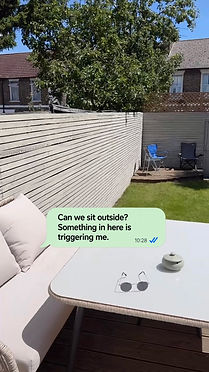
Foods, fragrances, laundry detergents, cleaning products, animals and other environmental triggers that most people wouldn't think twice about. At its worst, it genuinely felt like I was reacting to everything in the world around me.
When the things making you unwell are practically everywhere, it can become incredibly isolating.
I spent so much time researching, trying to find appropriate specialists and figuring out how to make my environment safer for my individual sensitivities.
The charity Mast Cell Action was incredibly helpful during that period, pointing me towards information and support when I felt completely lost. So if you see a lot of advocacy I'm doing with them, it's to give back and say thank you for their support when I needed it most.
Over the years, with medical treatment and extensive environmental adaptations, I've thankfully reached a much more manageable place than I was in back in 2020.
It still requires a lot of ongoing planning, boundaries and advocacy, and it's one of the reasons so many of the everyday adaptations I share might seem a little unusual to somebody who doesn't understand the condition.
From asking people not to wear fragrance around me to bringing my own food, cleaning products and bedding when travelling. These things aren't simply preferences. They're part of what helps make different environments accessible for me.
In 2024, another more rare condition that's likely mast cell mediated was diagnosed known as Hidradenitis Suppurativa (HS), with debilitating flares of abscesses, especially over the winter, that meant I'd cancel more plans as they make you feel systemically unwell, needing antibiotics and not even be able to walk or sit upright in a chair. Another addition of something to challenge my mobility...!


FINDING WAYS TO LIVE POSITIVELY
Something that has really shaped my perspective over the past few years is learning that living positively with chronic illness doesn't mean feeling positive all the time. I've had incredibly difficult periods, physically and mentally, and there are still days when symptoms feel overwhelming or I'm frustrated by what my body can't do.
But I've also spent a lot of time learning about mindfulness, meditation, gratitude and the ways our perspective can change when life becomes unpredictable.
One thing I've come to appreciate is that we don't necessarily have to wait until everything is perfect before allowing ourselves to experience happiness,because when you live with chronic conditions, there might not be a point where everything is suddenly resolved.
Instead, I've tried to find joy and appreciation in the everyday things that are still possible. Sometimes that might be something huge, like travelling somewhere beautiful. Other times it's something as simple as feeling well enough to go for a walk, spending time in the garden or enjoying a lovely afternoon at home.
I think learning to appreciate those moments, whilst still acknowledging the difficult ones, has been one of the most important parts of adapting to life with chronic illness.

GETTING MARRIED ABROAD WITH CHRONIC ILLNESS
In 2024, Rob and I got engaged after being together since we were teenagers, and in May 2025, we got married in Cyprus, surrounded by around 100 of our friends and family who travelled out to celebrate with us.
It was honestly the wedding of dreams!
But as you might imagine, organising a wedding abroad with multiple chronic illnesses and severe allergies involved a LOT of extra preparation. We travelled out nine days before the wedding so I could recover from the journey, pace myself, get everything organised and spend time doing gentle hydrotherapy in the sea.
We had to find accommodation that could accommodate my MCAS protocols, organise suitable meals, manage medical supplies and make sure the different locations and events were accessible. I also had to set boundaries around things like fragrance, physical contact, late nights and socialising so that I could give myself the best chance of feeling well on the day.
Whilst it was wonderful that my health was relatively manageable throughout the celebrations, that didn't happen without a huge amount of planning behind the scenes.
It's another experience I've been sharing because I think there's so much that can be learnt about making special occasions more accessible, whilst recognising that everyone's needs will be different.

MOVING INTO AN ACCESSIBLE HOME
Another enormous milestone for us was moving into our new home in 2026. After having our previous property on the market for two years, and several other properties not working out along the way, we finally found a bungalow that suited so many of my accessibility requirements.
Level access, more green space, and the ability to create a home environment around my particular needs.
Since being diagnosed, I've moved several times, and each experience has taught me more about how significantly our surroundings can affect everyday life with chronic illness.
Things that somebody else might not even notice, like stairs, flooring, room layouts, ventilation or how far away something is, can make an enormous difference.
With MCAS, moving into a new property comes with a whole other level of preparation, particularly when you need to consider previous occupants, fragrances, cleaning products, carpeting and building materials.
We ended up living through a few weeks of renovations whilst I was pregnant, which was certainly an experience! But honestly, having a home that better suits my needs, including space for my photography studio and now our growing family, has made such a difference.

BECOMING A MUM WITH MULTIPLE CHRONIC ILLNESSES
For as long as I can remember, I've always dreamed of becoming a mum. Some of my favourite childhood memories are doing arts and crafts and spending time in the kitchen with my own mum, and I've always imagined creating those kinds of memories with my own family one day.
Of course, when you have multiple disabling chronic illnesses, the idea of pregnancy, birth and motherhood can come with an enormous number of extra questions and considerations.
-
How will pregnancy affect my conditions?
-
What will I be able to manage physically?
-
Which adaptations might make looking after a baby more accessible?
-
How will we navigate sleep deprivation, symptoms, medical appointments and all the unpredictability of life with a newborn?
I had SO many things to research and plan. But it's also something I'd always wanted to experience, and I was determined to find ways to make it work.
In December 2025, the day we returned from our honeymoon, we found out I was pregnant with our first baby. My pregnancy came with plenty of challenges, particularly severe nausea and fatigue during the first trimester, but also some surprising improvements in certain symptoms during the second trimester.
I spent a lot of time researching adaptations that might make motherhood more accessible, from an electric-assist pram to different cot setups, supportive furniture and ways to reduce unnecessary bending or lifting. Then in August 2026, our little baby boy arrived! His birth was far from what we'd originally hoped or prepared for, involving a long induction, emergency C-section and serious infection that resulted in a two-week hospital stay.
Despite all the preparation I'd done, there were so many unexpected lessons about medical advocacy, navigating complex conditions in hospital and learning when plans need to change. Now we're navigating this whole new chapter of parenthood, finding our feet as a family of three and continuing to learn what works for us along the way.
I've already got SO much to share about the adaptations, challenges and experiences of becoming a mum with chronic illness.

WHY POSITIVELY CHRONIC_?
When I first created this platform in 2020, it was called Positively Chronic Travels.
At the time, that made perfect sense.
We'd just set off on our long-awaited travels, and I'd spent an enormous amount of time researching how to make travelling possible with complex health conditions.
As the years have gone by, the things I've wanted to share have expanded enormously. Chronic illness doesn't just affect us when we're travelling. It affects how we work, socialise, organise our homes, access healthcare, manage relationships, celebrate milestones, and now for me, how I navigate motherhood.
There are so many adaptations, resources and little things I've learnt along the way that could be useful to somebody else.
So six years on, I've decided to drop 'Travels' from the name and evolve the platform into
Positively Chronic_
The underscore is a little blank space for whatever comes next.
Positively Chronic_ Life
Positively Chronic_ Travel
Positively Chronic_ Motherhood
Positively Chronic_ and all the other areas of life that we learn to navigate with chronic illness.
Because whilst our individual experiences and circumstances might be completely different, I think there's so much we can learn from sharing them.
AND THAT'S WHAT THIS SPACE IS ALL ABOUT
When I was first diagnosed, I spent SO much time trying to find information, understand my conditions and figure out how to adapt everyday life. Whilst I found lots of useful resources, they were often scattered across different places, and it took an enormous amount of research to put everything together.
I wanted to create somewhere that combined practical information with real experiences, including the things that don't necessarily get explained during medical appointments.
-
The planning behind everyday activities.
-
The adaptations that make things possible.
-
The importance of advocating for our needs.
-
The reality that life with chronic illness can be incredibly challenging, whilst still being full of meaningful experiences.
I don't pretend to have all the answers, and what works for my particular combination of conditions certainly won't work for everybody.
But hopefully, by sharing what I've learnt, what I've tried and what life actually looks like behind the scenes, I can help somebody else feel a little more informed, prepared or understood.
And perhaps even save you some of the time and energy involved in figuring everything out yourself.
Thank you for being here and following along with this ever-evolving journey! 💞
Katya x